Room Rental Contract: A Practical Guide to Professional Agreements
In the landscape of property management and shared living arrangements, clarity is the most valuable currency. Whether you are a landlord managing a single investment property, a business owner offering co-working spaces, or an individual renting out a spare room, the foundation of a successful tenancy lies in the documentation. A Room Rental Contract serves as this critical foundation. It is not merely a formality but a strategic tool designed to define expectations, protect assets, and prevent misunderstandings before they escalate into costly disputes. For professionals and small business owners looking to elevate their operational standards, utilizing a well-structured, editable agreement template is often the first step toward establishing credibility and ensuring legal compliance.
The Strategic Value of a Formalized Agreement
The primary purpose of a room rental agreement extends beyond simply stating the rent amount and due date. Its true value lies in its ability to articulate the specific rules of engagement between the lessor and the lessee. In real-world scenarios, conflicts often arise from ambiguous verbal agreements or assumptions about utility usage, guest policies, and maintenance responsibilities. A comprehensive Room Rental Contract mitigates these risks by providing a written record that both parties have reviewed and accepted.
For entrepreneurs and service providers, the presentation of this document reflects directly on their brand. Handing over a generic, poorly formatted piece of paper can undermine confidence in your professionalism. Conversely, presenting a clean, organized, and visually professional agreement signals that you take your business seriously. This perception of reliability can be the difference between securing a high-quality tenant and losing them to a competitor who appears more established. Therefore, the aesthetic and structural quality of the contract are just as important as the legal clauses it contains.
Evaluating Template Quality and Usability
When selecting a template for your needs, several factors determine its practical utility. The best templates strike a balance between legal robustness and user-friendly customization. A high-quality Simple Room Rental Contract template should be intuitive to edit, allowing you to input specific details without needing advanced graphic design skills or legal expertise.
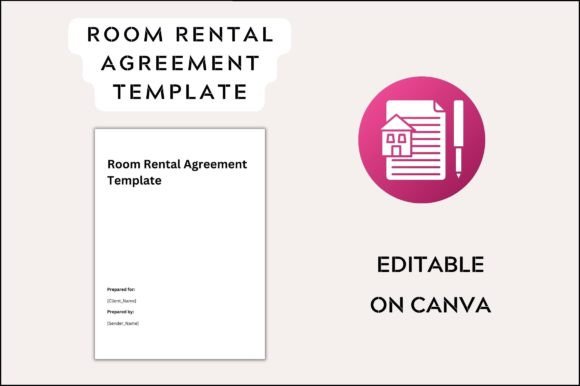
Consider the flexibility of the file format. Modern workflows demand adaptability. Templates built on platforms like Canva offer significant advantages because they allow for drag-and-drop editing. This means you can easily swap out logos, adjust color schemes to match your brand identity, and modify fonts to ensure readability. The ability to resize elements or change the background color ensures that the document does not look like a mass-produced generic form but rather a bespoke asset created specifically for your business.
Furthermore, the output options are crucial. A versatile template should allow you to download the final document in various formats, such as PDF for official signing, or PNG and JPG for digital previews. Having access to editable source files ensures that if laws change or your business policies evolve, you can update the document instantly without starting from scratch. This long-term adaptability adds substantial value, saving countless hours of administrative work over time.
Key Components of an Effective Contract
A functional room rental agreement must cover specific areas to be effective. While legal requirements vary by jurisdiction, certain core elements are universally necessary for a sound agreement:
- Parties Involved: Clear identification of the landlord (or business entity) and the tenant, including contact information.
- Property Description: A precise definition of the rented space, distinguishing between private rooms and shared common areas like kitchens or bathrooms.
- Financial Terms: Explicit details regarding rent amounts, payment schedules, accepted payment methods, and penalties for late payments.
- Duration and Termination: Start and end dates of the lease, along with the notice period required for termination by either party.
- Rules and Regulations: Policies on guests, noise levels, smoking, pets, and the use of shared facilities.
- Maintenance and Repairs: Delineation of responsibilities regarding who handles repairs and how maintenance requests should be submitted.
Templates that include sample files alongside the editable version are particularly beneficial. These samples serve as a guide, showing you how to fill out the fields correctly and offering examples of standard clauses. This reduces the cognitive load on the user and minimizes the risk of omitting critical information.
Who Benefits Most from Editable Templates?
The utility of a premium, editable room rental agreement spans a wide range of users. Small business owners who operate boutique hostels, co-living spaces, or student housing complexes benefit immensely. For them, consistency is key; using a standardized template ensures that every tenant receives the same terms, reducing the likelihood of claims of unfair treatment.
Freelancers and creators who rent out studio space or equipment storage also find these tools invaluable. In these niche markets, a standard residential lease may not suffice. An editable template allows them to insert specific clauses related to their unique industry needs, such as insurance requirements for stored goods or restrictions on commercial activity within the rented room.
Even individual homeowners renting out a dorm room or a private suite can leverage these tools to look more professional. By moving away from handwritten notes or informal text messages, they establish a formal boundary that protects their personal home and privacy. The psychological impact of a signed, professional document often encourages tenants to treat the property with greater respect.
Practical Considerations and Limitations
While a well-designed template provides a strong framework, it is essential to recognize its limitations. No template can replace specific legal advice tailored to local laws. Zoning regulations, tenant rights acts, and eviction procedures vary significantly from city to city and state to state. Therefore, while a Room Rental Contract template offers an excellent starting point, it should be reviewed against local regulations before finalization.
Additionally, the ease of editing can sometimes lead to over-customization. Users should resist the urge to remove standard protective clauses in favor of brevity. The strength of a pre-built template lies in its inclusion of tried-and-tested language that covers common pitfalls. Stripping away these elements to make the document "simpler" may inadvertently expose the landlord to liability.
From a technical standpoint, ensuring that the final printed version maintains its formatting is vital. Templates designed for A4 standard size generally print well globally, but users should always perform a test print to check margins and alignment. Digital distribution is equally important; ensuring the PDF is secure and cannot be easily altered by the tenant after signing is a best practice for maintaining document integrity.
Maximizing Efficiency in Property Management
Time is a non-renewable resource for any business owner or landlord. The process of drafting a legal document from scratch can take hours of research and writing. By utilizing a premium room rental agreement template, this process is reduced to minutes. The ability to download, customize, and print immediately allows professionals to focus on higher-value tasks such as marketing their property, screening tenants, or managing improvements.
The consistency provided by these templates also aids in record-keeping. When every lease follows the same structure, comparing terms across different tenants or renewing leases becomes a streamlined administrative task. This organizational efficiency contributes to the overall health of the business, reducing errors and ensuring that no critical deadlines or obligations are overlooked.
In conclusion, adopting a professional, editable room rental contract is a low-cost, high-impact decision for anyone involved in renting space. It bridges the gap between informal arrangements and formal business practices. By choosing a template that offers flexibility, clarity, and professional presentation, landlords and business owners can foster better relationships with their tenants, protect their interests, and operate with a level of professionalism that commands respect. The investment in a quality template pays dividends in peace of mind and operational smoothness, making it an essential tool in the modern property management toolkit.