Just Listed Real Estate Postcard: A Practical Guide to Winning Local Listings
In the fast-paced world of real estate, timing isn't just everything; it's the only thing. When a new property hits the market, the clock starts ticking not just for potential buyers, but for agents looking to establish dominance in a neighborhood. This is where the Just Listed Real Estate Postcard becomes more than just a piece of mail—it transforms into a strategic tool for brand authority and immediate engagement. Whether you are a seasoned broker or an up-and-coming agent, understanding how to leverage these postcards effectively can be the difference between being seen as a local expert or just another name in the mailbox.
The concept is straightforward, yet its execution requires nuance. A "Just Listed" announcement serves a dual purpose. Primarily, it informs the immediate community that a new home is available. However, its secondary, often more valuable function, is signaling to neighbors that you are the active force driving movement in their area. When residents see a professional, eye-catching card announcing a sale next door, it subtly reinforces the idea that if they were to sell, you would be the one to call. It's about planting seeds of trust before the need even arises.
Scenarios Where Impact Matters Most
Different real estate environments demand different approaches, and the versatility of a Premium Just Listed Real Estate Postcard allows for adaptation across various scenarios. Consider the suburban family neighborhood. Here, the audience is often comprised of long-term residents who know everyone on the block. In this context, the postcard acts as a conversation starter. Neighbors are naturally curious about who is moving in and what the new listing looks like. A well-designed card with high-quality images satisfies that curiosity while positioning the agent as the source of reliable information.
Contrast this with a luxury urban condo market. The dynamics shift from community curiosity to exclusivity and prestige. In these high-stakes environments, the design quality of the postcard reflects directly on the perceived value of the property. A generic or poorly formatted flyer can inadvertently lower the perceived worth of a multi-million dollar unit. Using a template that allows for full customization of fonts, colors, and elements ensures that the aesthetic matches the sophistication of the listing. It tells the recipient that every detail has been considered, from the marble countertops to the paper stock of the invitation to view.
Another critical scenario involves farming a specific zip code. Agents who specialize in a particular area rely on consistent visibility. Sending out a Just Listed Real Estate Postcard every time a home goes on the market in that zone builds a rhythm of recognition. Over time, residents begin to associate your face and branding with local activity. It's a psychological game of presence; if you are the one announcing the news, you are implicitly the expert on the news itself.
Tailoring the Message for Different Audiences
The beauty of modern templates, particularly those editable via tools like Canva, lies in the ability to pivot your message based on who is holding the card. For potential buyers, the focus is on the features: square footage, number of beds and baths, and stunning photography. The card needs to scream "opportunity." You want them to feel a sense of urgency, perhaps even a fear of missing out (FOMO), prompting them to scan a QR code or visit a landing page immediately.
However, when the target audience is the surrounding neighbors—potential future sellers—the narrative changes. While the property details remain, the subtext shifts to market performance. Smart agents use the space to include a brief note about how quickly the home went under contract or how it compares to recent sales. This turns a simple announcement into a mini-market report. It answers the unspoken question every homeowner has: "What is my home worth right now?" By addressing this indirectly, the postcard becomes a lead generation magnet for seller consultations.
Investors represent a third distinct audience. They aren't looking for dream homes; they are looking for numbers and potential. For this group, the postcard might highlight investment metrics or the speed of the transaction. A clean, data-forward design often resonates better here than an emotional, lifestyle-focused layout. The ability to resize and reformat your template means you can create variations for these different segments without starting from scratch each time.
Practical Considerations Before You Print
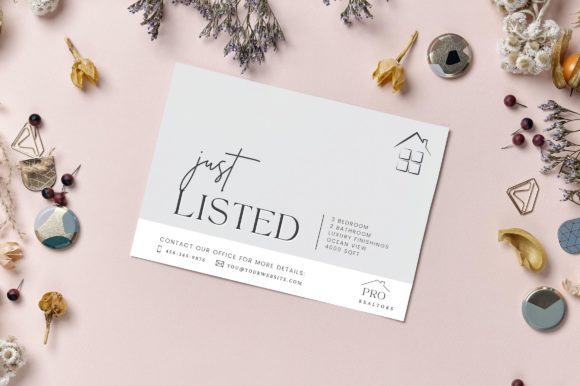
Before rushing to print, there are several practical factors to weigh to ensure your campaign yields results. First, consider the visual hierarchy. The headline "Just Listed" should be immediate, but the agent's branding must be equally prominent. If the recipient remembers the house but forgets the agent, the marketing effort is only half successful. Ensure your photo, logo, and contact information are clear and legible. This is where using an editable file link becomes invaluable. Being able to tweak font sizes or move elements to balance the composition can make a significant difference in readability.
Color psychology also plays a subtle role. While you want to stay true to your brand guidelines, consider the mood of the listing. A beachfront property might benefit from cool blues and airy whites, while a cozy cabin listing might shine with warmer earth tones. Templates that allow you to change the BG Color and individual elements give you the freedom to match the vibe of the property without sacrificing your core brand identity.
Timing is another crucial consideration. A postcard that arrives two weeks after the listing is live loses its impact. The workflow needs to be seamless. Having a Ready to Print Template PDF Format means that once the photos are approved and the description is written, the physical production can begin immediately. Delays in design often lead to missed windows of opportunity, especially in hot markets where properties go pending within days.
Maximizing Efficiency with Digital Tools
Gone are the days of waiting hours for a graphic designer to mock up a single flyer. The integration of user-friendly platforms like Canva has democratized high-quality design for real estate professionals. With a template size of 148 X 105 mm (or resizable to fit standard US postcard dimensions), you have a foundation that is already optimized for print. The ability to download in various formats like PNG, SVG, JPG, or PDF ensures compatibility with any printing service, whether you are using a local shop or an online bulk printer.
The efficiency gain here is substantial. Imagine having a new listing on Friday afternoon. Instead of scrambling to create graphics over the weekend, you open your pre-built template, swap the images, update the address and price, and send the file to print. This saves priceless time, allowing you to focus on showing the property and negotiating offers. Furthermore, because these templates are fully editable, you aren't locked into a rigid design. If a client wants to emphasize a specific feature, like a newly renovated kitchen, you can easily rearrange elements to highlight that aspect.
Strengths and Limitations to Keep in Mind
The primary strength of the Just Listed Real Estate Postcard is its tangibility. In an era dominated by digital noise, a physical object in the hand commands a different level of attention. It sits on the kitchen counter, gets pinned to the fridge, or is passed around among neighbors. It has a lifespan that a social media post, which disappears in hours, simply cannot match.
However, there are limitations. Direct mail can be expensive if not targeted correctly. Blanketing an entire city is rarely cost-effective. The strategy works best when hyper-localized. Additionally, a poorly designed card can do more harm than good. If the images are pixelated, the text is cluttered, or the colors clash, it reflects poorly on the agent's attention to detail. This is why starting with a Premium template that has been professionally structured is essential. It provides a safety net against design errors while offering the flexibility to make the content your own.
Ultimately, the goal is to build a bridge between the property and the people. Whether you are celebrating a new sale, hunting for your next listing, or simply keeping your name top-of-mind, the right postcard strategy anchors your presence in the community. By combining high-quality visuals with strategic messaging and efficient workflows, you turn a simple piece of paper into a powerful engine for business growth.